
Card:
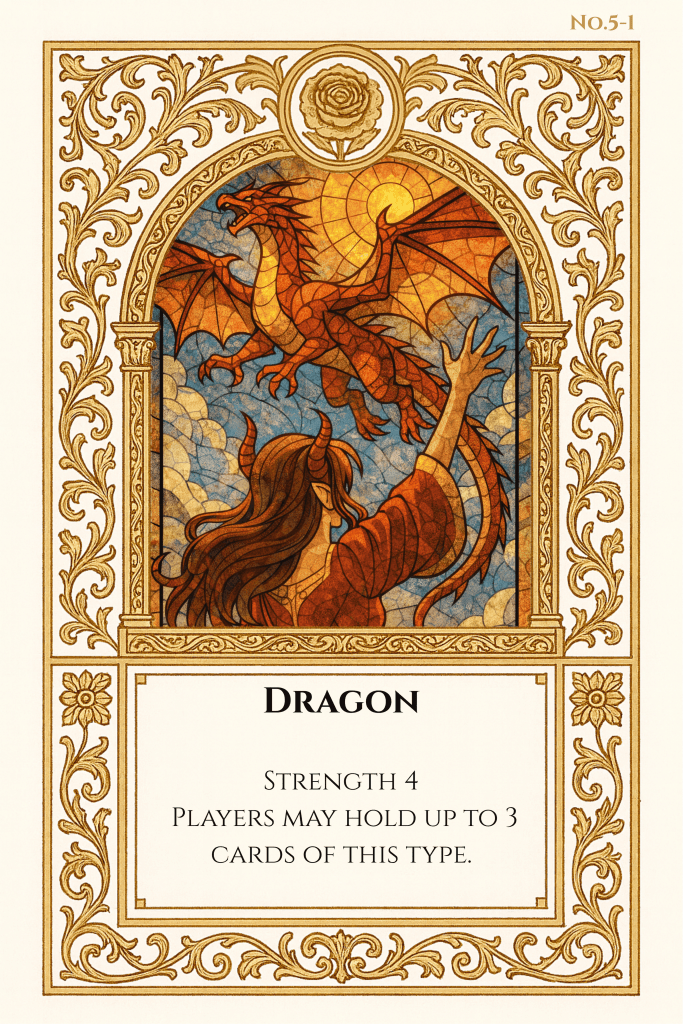
Ability
Strength=4
Description
With the establishment of the Skykoran Aerial Corps, dragonkind was, for the first time, fully integrated into the standing armies of the known world. What began as an innovation of necessity soon became doctrine: in the decades that followed, nations across the continent sought to incorporate dragons into their own military hierarchies. In most realms, dragons were not merely soldiers, but figures of rank, often bearing noble titles as recognition of both their rarity and strategic value.
Yet such power comes at considerable cost. The maintenance of a dragon corps demands vast resources, and as such, their numbers remain limited even among the great maritime empires. In powers such as Skykor or Koranville, a full complement rarely exceeds one hundred and fifty to two hundred individuals. In states of lesser scale, the number is more commonly between forty and eighty. Some nations, lacking the means or infrastructure to sustain such forces, instead employ dragon mercenaries. These individuals, however, are seldom subject to standardized training, and their capabilities vary greatly as a result.
Beyond the field of war, dragonkind occupies a wide range of roles within society. It is not uncommon to find dragons serving as magisters, financiers, merchants, or alchemists, their longevity and capacity for endurance lending themselves to disciplines requiring both precision and sustained effort. They are also noted for particular appetites—favoring strong spirits and foods of high caloric density, both necessities rather than indulgences.
Physiologically, dragons differ from humankind in both scale and function. Depending on lineage, an adult dragon typically measures between eight and eighteen meters in length. Their natural body temperature ranges between 44 and 46 degrees Celsius, granting them accelerated metabolic processes, enhanced immune resilience, and the capacity to rapidly convert food into the energy required for sustained flight. This elevated temperature is accompanied by higher baseline blood pressure, enabling effective operation at high altitudes.
In their true form, a dragon’s basal metabolic demand is estimated between sixty and one hundred twenty thousand kilocalories per day. Under conditions of sustained high-intensity exertion, this requirement may rise to between one hundred eighty and three hundred sixty thousand kilocalories—equivalent to over one hundred times that of a human. As a consequence, dragons may spend between three and nine hours each day in consumption alone.
It is for this reason that many adopt a humanoid form, through which metabolic demands may be partially reduced. Even so, such a state still requires an intake of approximately ten to twelve thousand kilocalories daily, several times that of a human. Thus, the sight of a horned figure perpetually in the act of eating should not be mistaken for indulgence; it is, in truth, a matter of necessity.
In terms of physical capacity, dragonkind surpasses human limits by a wide margin. Their structural resilience is estimated to exceed that of a human body by at least fiftyfold, and they are capable of withstanding extreme gravitational forces—potentially up to five hundred times standard gravity. This allows for rapid aerial maneuvers and abrupt directional shifts that would be otherwise impossible for human beings.
For all their power, however, dragons remain constrained by the very conditions that sustain them. They are few, costly, and bound by the demands of their own bodies. To command dragons is to command supremacy—but only so long as such supremacy can be fed, maintained, and endured.
On the Origins of Dragonkind
The true origin of dragonkind remains a matter of dispute among scholars, though most surviving accounts trace their emergence to the age of the Divine Wars. In those distant conflicts—where the powers of the gods contended openly—there arose the need for beings capable of contesting dominion over the skies.
It is said that dragons were not born as they are now, but made.
Certain records, often preserved in fragmentary form, suggest that the earliest dragons were the result of a transformation—one undertaken by human magisters in concert with divine forces. In pursuit of power sufficient to alter the course of war, they relinquished their mortal form, surrendering the limits of the human body in exchange for mastery of the air and the capacity to wield immense arcane force. What emerged from this act was neither wholly divine nor wholly human, but something forged between the two.
Such accounts frequently describe this change as a sacrifice. The loss of human appearance was not merely physical, but symbolic—a severance from the familiar, replaced by forms that inspired awe, fear, and authority in equal measure. In this sense, dragonkind may be understood not only as weapons of war, but as relics of a choice: to become something greater, at the cost of remaining what one once was.
In later eras, it was discovered that dragonkind retained the ability to assume a human form. This transformation, however, is seldom complete. Many choose to preserve certain features—most notably the horns—as a mark of identity, or perhaps as a reminder of what was given up in their creation.
Notably, dragonkind bears no fundamental separation from humankind in matters of lineage. They are capable of intermingling without barrier, and are classified not among the oviparous creatures often imagined in folklore, but among those that bear live offspring. This fact has led some to argue that, whatever their present form, dragons remain—at their origin—profoundly human.
Whether these accounts are to be taken as literal truth or as the mythologized memory of an age long past remains uncertain. Yet even in doubt, one conclusion endures:
Dragonkind did not arise by chance.
They were made for war.
 Queen's Men Studio