
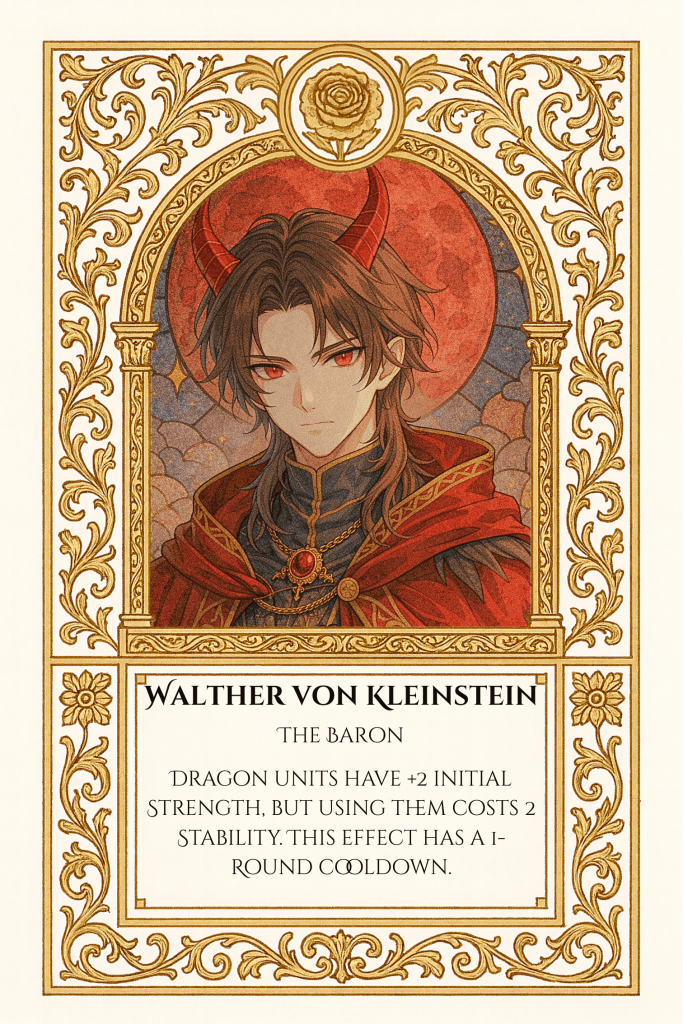
The Baron
Nationality:
The Skykor Empire
Lineage:
Drakons / Jervainwyrm
Personality:
Proud, composed, and marked by a certain degree of obsession.
The Baron directs most of his strikes toward an opponent’s wings, tail, and joints rather than the head or vital organs, seeking to disable rather than to kill whenever possible.
Description:
Walther von Kleinstein, later styled “the Crimson Baron,” was a dragon of Jervainberg origin. In his early years, he departed from his homeland and spent a considerable period in wandering, before at last taking residence in Skykor. He had no known intention of binding himself to any crown; yet upon the outbreak of war between Skykor and Koranville, he was invited into the Skykoran Aerial Corps, at a time when the northern coasts of the realm had already suffered landings by Koranvillian forces and the line of defense remained unsettled.
His first engagement was not fought in the heavens, but upon the land. Ascending alone and without the benefit of formal formation, he struck at the Koranvillian troops newly disembarked along the northern shores of Skykor. Contemporary records note that he broke an entire landing force in a single assault, not by indiscriminate destruction, but through the calculated disruption of supply lines, command structure, and formation cohesion. It is remarked in several accounts that the number of wounded far exceeded the dead, a circumstance at the time dismissed by some as clerical error, until corroborated by multiple witnesses.
As the war advanced, Koranville secured the service of dragon mercenaries from Nordweil, and the character of the conflict changed at once. In response, Skykor established specialized hunting formations—so-called Striker Teams—tasked with engaging and neutralizing hostile dragons. Walther was appointed as one of the leading commanders of such a unit. It was in this phase of the war that his singular method of combat became widely observed: he would seldom strike at the head or vitals, but instead aimed with precision at wings, tail, and joints, rendering his opponents incapable of sustained flight or battle. What had first been regarded among his peers as arrogance, or even folly, gradually came to be understood as a discipline of higher control.
Over the course of the war, Walther was credited with twenty-two aerial kills. This number must be understood in proper measure: at the time, the standing strength of the Skykoran dragon corps numbered approximately forty active dragons, with a further twenty held in reserve. By calculation against the effective strength of his own service, the losses he inflicted were judged to be equivalent to nearly half the fighting capacity of the corps itself—a comparison often employed in later military analyses to convey the scale of his impact.
In tandem with his record, his crimson-scaled form acquired a reputation of its own. Among Koranvillian ranks there arose a saying, oft repeated in reports and recollections alike: that when a streak of red appeared in the sky, the outcome of the engagement had already been decided. The psychological effect was such that even within Skykor’s own forces, certain dragons took to painting their scales in red before ascent, in imitation of the Baron’s dread image. This practice came to be known as “war paint,” and persisted well beyond the campaigns in which it was born.
In the later stages of the war, Koranville sought to cripple Skykor’s naval strength by destroying the great shipyards of Saint Thom. Walther and his company were dispatched to hold the skies above the harbor, where they maintained resistance over the course of seven consecutive days of aerial engagement. During this period, he encountered repeatedly the Koranvillian champion known as Fenrir. Their final clash ended in Fenrir’s defeat; yet victory came at cost. A magical missile detonated in close proximity to Walther’s head, inflicting severe trauma. Though he survived the encounter, he was thereafter unable to endure the strain of sustained aerial combat.
Not long after, the introduction of a new generation of Skykoran battleships shifted the balance of the war. Koranville’s position deteriorated, and the conflict concluded in its defeat. Walther von Kleinstein did not remain in service to witness the full settling of peace. He withdrew from the skies before the final outcome was secured, and from that point forward, official records concerning him grow scarce.
Judgments upon his legacy remain divided. Some hold that he redefined the nature of aerial warfare, demonstrating that to defeat and to kill are not one and the same. Others contend that his restraint served only to prolong the war he so masterfully controlled. Yet it is beyond dispute that, for a brief span of years, the skies of Skykor were governed by a different principle—one in which mastery was measured not by destruction, but by the precision of restraint.
Secret:
In the years following the war, he was elevated to the rank of Count and granted lands in recognition of his service. Yet in both formal address and common speech, he continued to be known as “the Baron.” Whether this was by personal preference or by the persistence of reputation remains uncertain. Many have noted, however, that it was under that lesser title that his name first came to command the skies, and it is by that name that history has chosen to remember him.
Abilities (March 5th, 2026):
Dragon units have +2 initial Strength, but using them costs 2 Stability. This effect has a 1-Round cooldown.
 Queen's Men Studio